
From “Mr. S” to RCTC: Why Rochester’s Police Officers Came to Scott to Learn Crime Scene Photography
Scott Schoeberl was a high school photography teacher in Chaska, Minnesota, long before he photographed Mayo Clinic physicians, families on Oxbow Park trails, and seniors who treat their portrait sessions like Vogue cover shoots. His students called him “Mr. S.” because his last name was just genuinely hard to spell, harder to pronounce.
Mr. S had long hair and acted tough. Mr. S ran his darkrooms like a man who would absolutely not tolerate horseplay around expensive enlargers and trays of developer, and the freshmen believed him…for about a semester. Eventually, every class figured out the same thing: the long-haired tough guy was a softie. He let students earn extra credit by answering Saved by the Bell trivia, and he sold them candy to replace the equipment they broke. They saw through him completely, and they loved him for it.
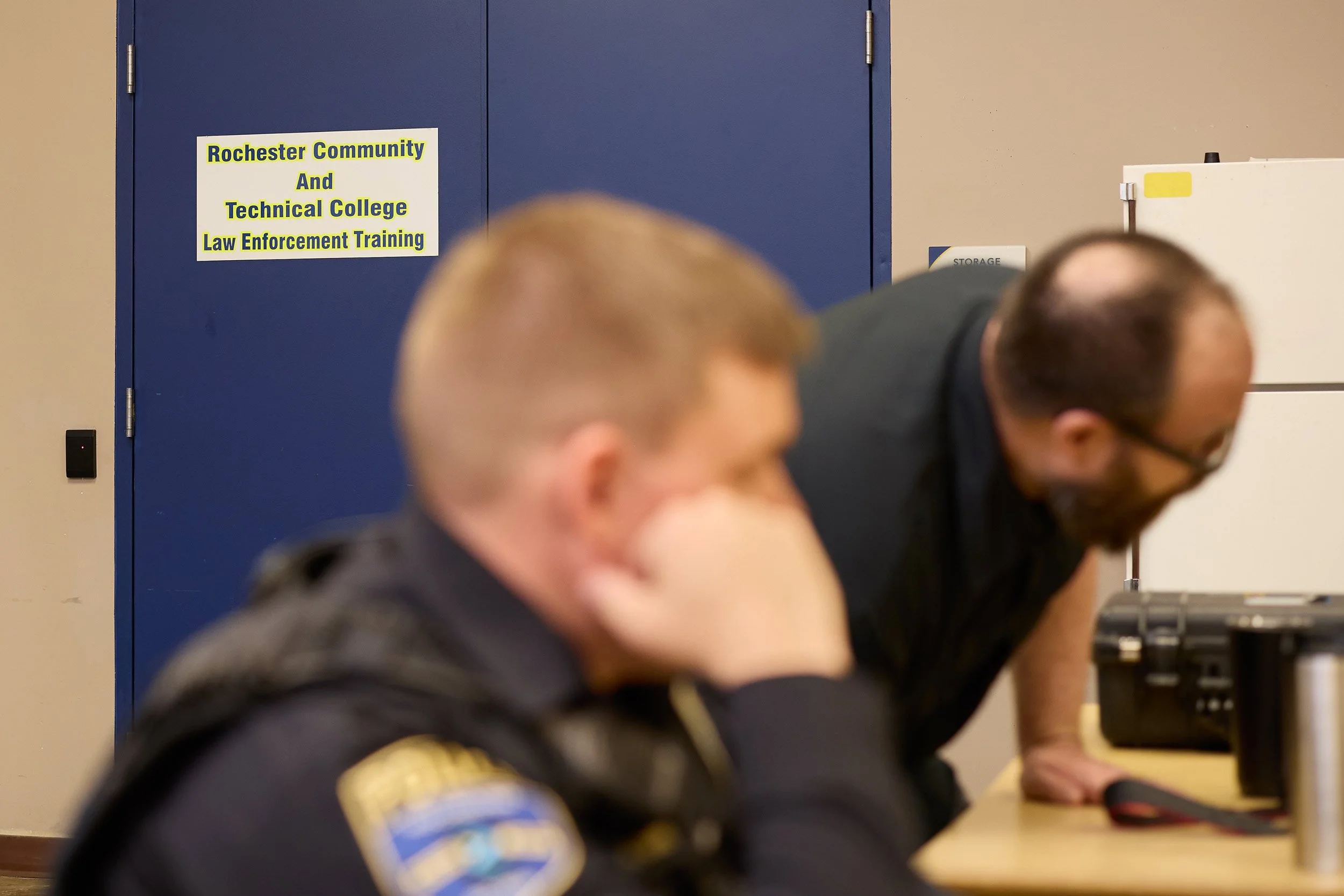
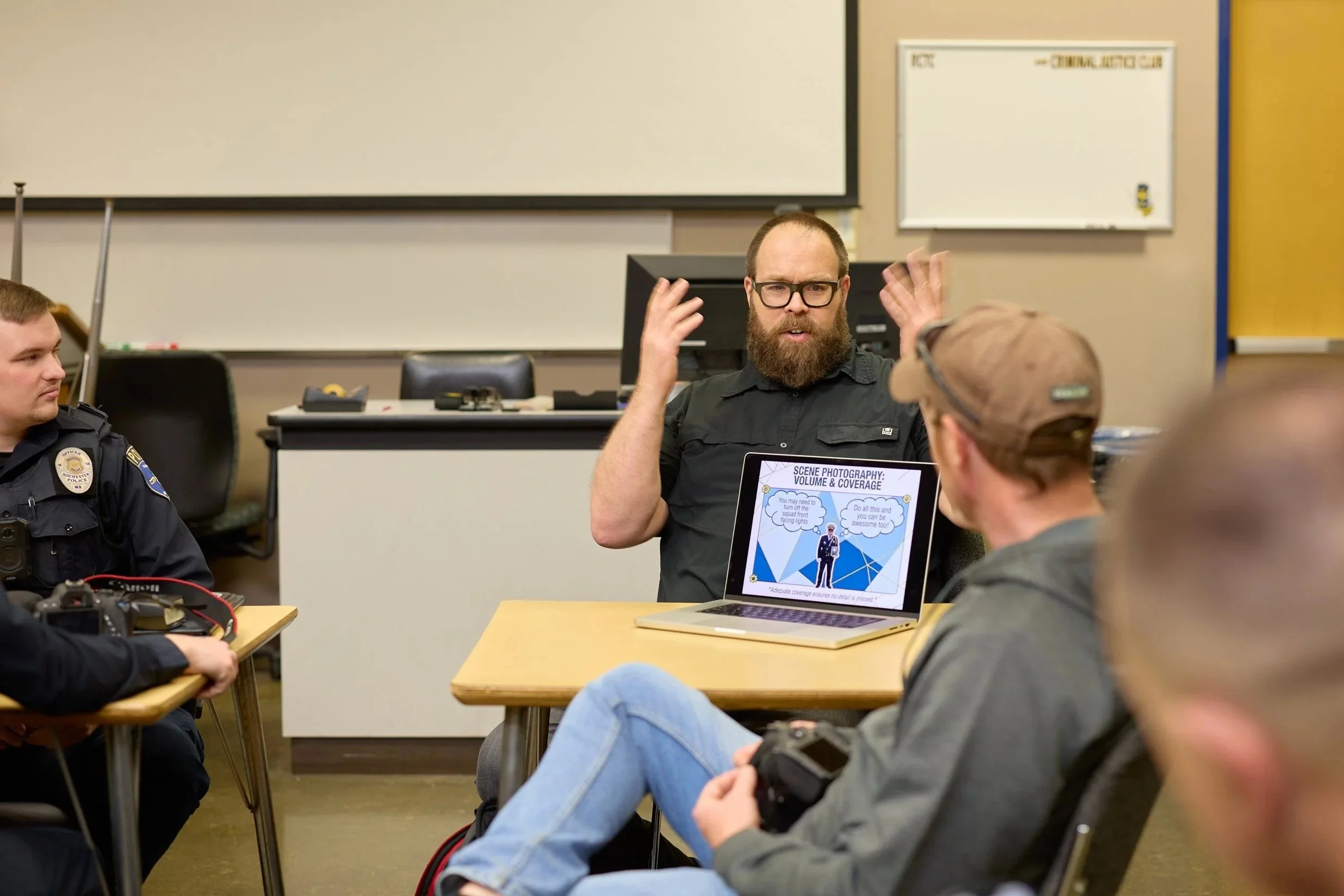
Twenty-five years of professional photography later, Scott found himself standing in front of a different kind of classroom: a room full of police officers from the City of Rochester and sheriffs from Olmsted County, gathered at Rochester Community and Technical College for a course on Crime Scene Photography: Vehicle and Crash Documentation. This time, he didn’t need to act tough (he let them be the tough guys). He just had to teach them how to make the camera tell the truth.
Why Crime Scene Photography Is Harder Than It Looks
When most people picture a crime scene photographer, they imagine someone with a flash, snapping evidence markers next to tire tracks. What they don’t picture is the lighting situation: a wet, reflective road at 2 a.m., red and blue strobes from squad cars firing in every direction, a fogged-up windshield, glare from a streetlight directly behind the subject, and a body of evidence that has to be admissible in court three years from now.
Bad photos lose cases. Photos that are too dark, too blurry, or color-shifted in a way that misrepresents the scene can get evidence thrown out, weaken testimony, or hand a defense attorney exactly the opening they were hoping for. Good photos hold up. Officers know this.
What Scott Taught Rochester PD and Olmsted County Officers
The class focused on scenarios that actually compromise crash and vehicle photos in the field — real conditions Minnesota officers face on real shifts.
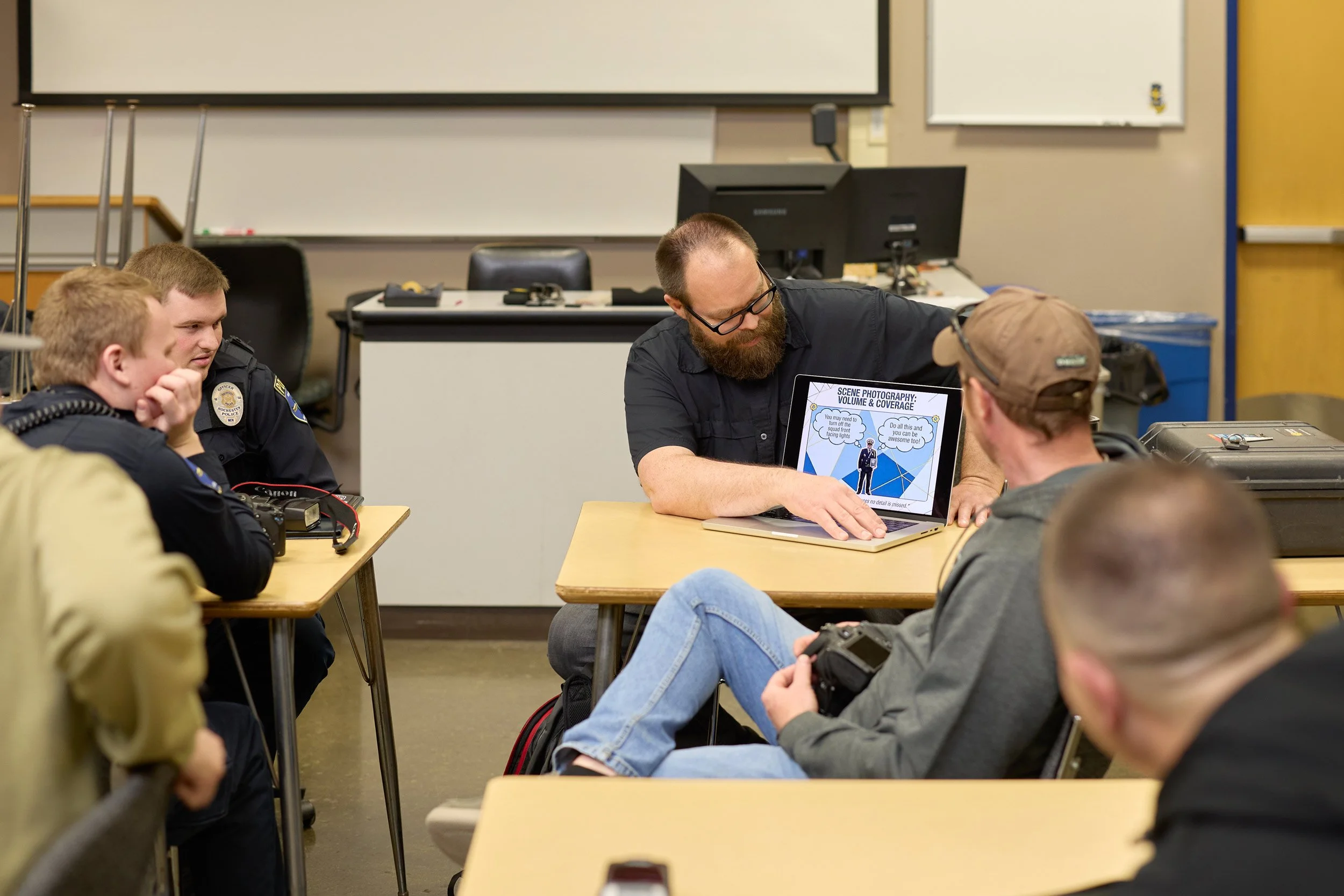
Topics included:
Shooting in the Dark: Defeating the Sensor's Limits
A camera sensor cannot automatically adjust to dark scenes like the human eye. Scott taught officers to bypass handheld limits using tripod stabilization and precise exposure control. They learned to balance the f/8 to f/11 "Pro Zone" for maximum depth of field against an ISO noise ceiling, ensuring digital grain never destroys fine evidentiary details under street lamps or headlights.
Shooting Under Harsh Light: Managing Dynamic Range
Midday sun glaring off a chrome bumper forces a camera to choose between extreme highlights and deep shadows. Scott taught the class how to take control using spot metering and mandatory "fill flash". By forcing the flash to fire in broad daylight, officers can punch light deep into a crushed vehicle cabin, revealing critical internal evidence rather than a pitch-black void.
Executing External Light: Speedlight Mechanics
Scott trained the room on the advanced physics of built-in and external speedlights, covering flash synchronization limits and manual TTL power overrides. He demonstrated how to overpower the "disco effect" of emergency vehicle strobes and how to properly bounce flash off interior roofs to illuminate a cabin evenly without blowing out details.
Focus Issues in Rain, Snow, and Pitch Black
Autofocus systems endlessly "hunt" when facing heavy precipitation or total darkness. Scott showed officers how to defeat environmental backscatter (glowing orbs caused by flash hitting rain) by taking the light off-axis. He also taught manual focus overrides using the external flash's AF-assist grid and "The Flashlight Trick" to lock razor-sharp focus before firing.
Glare, Reflection, and Micro-Detail Control
Scott taught the physics of lighting angles, showing how stepping slightly off-axis causes glare to bounce away from the lens. He also demonstrated oblique lighting—raking an off-camera flash horizontally across asphalt to make invisible skid marks pop.
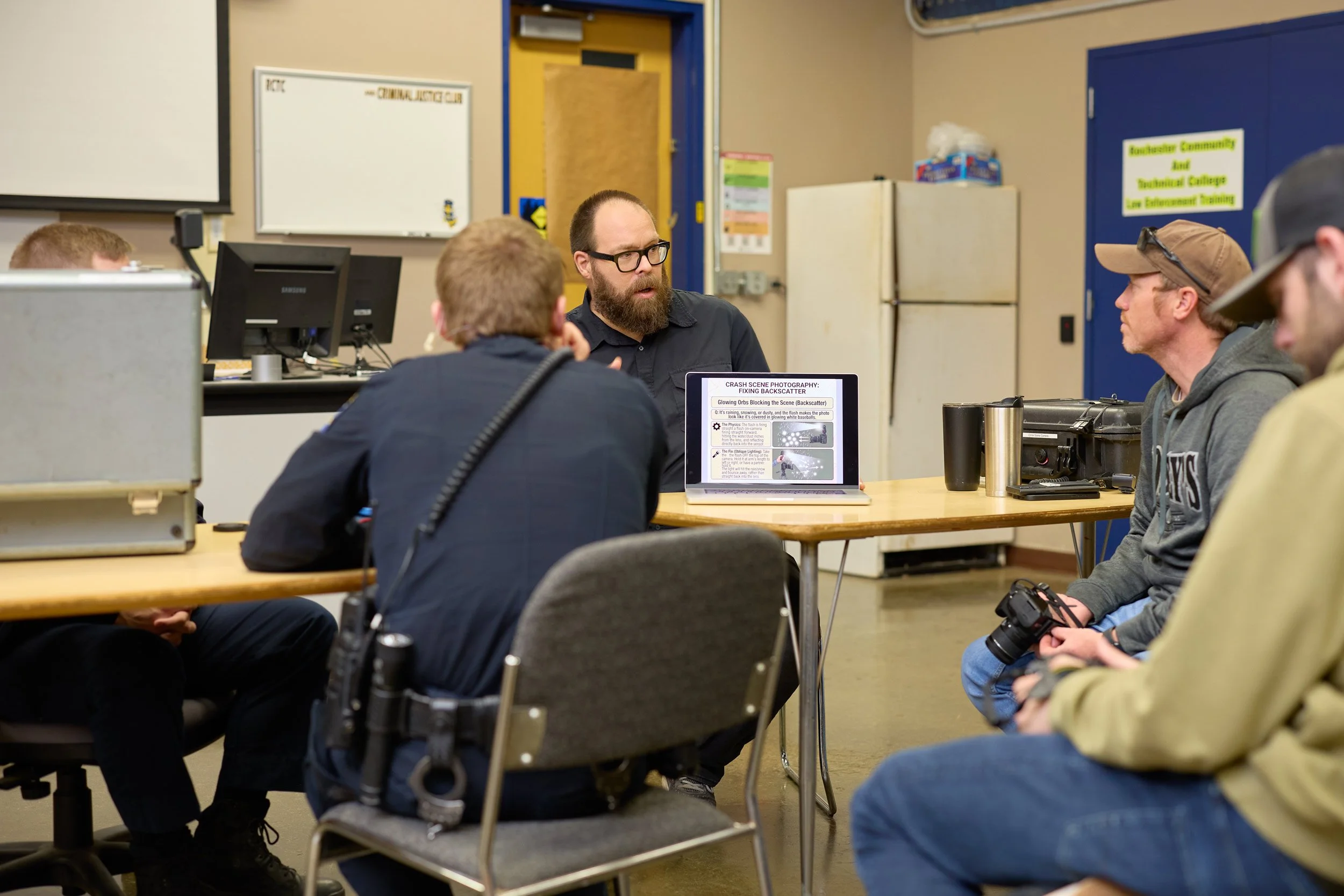
Every technique tied back to the same goal: photographs that hold up. Photographs a prosecutor can use, a jury can read, and a judge won’t question.
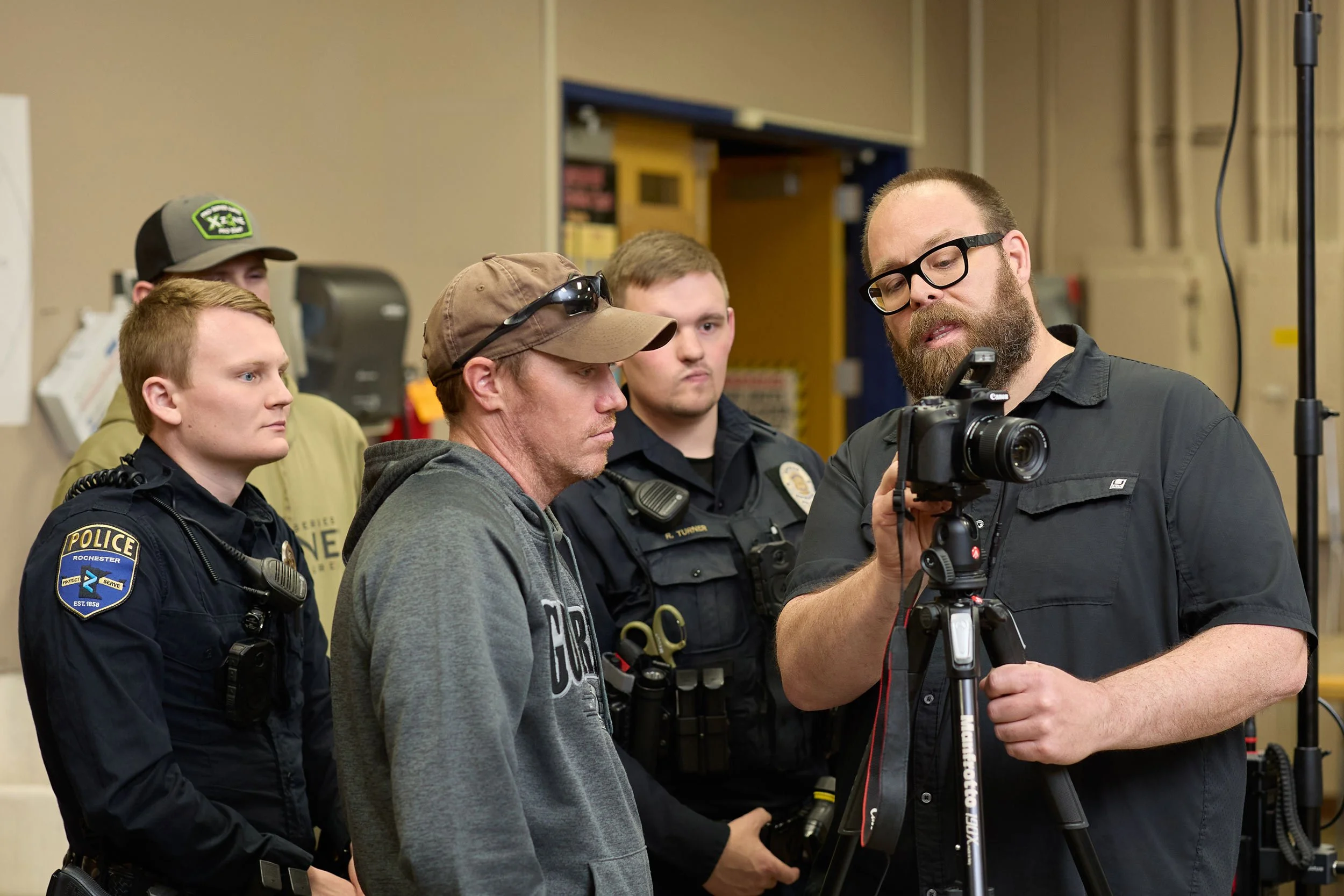
Meet BOB, the Hardest-Working Volunteer in Rochester
Long-exposure photography in low light is one of those skills you can’t really learn from a slideshow. You have to do it. Repeatedly. With something roughly human-shaped to focus on, so the techniques translate to actual scenes.
Enter BOB.
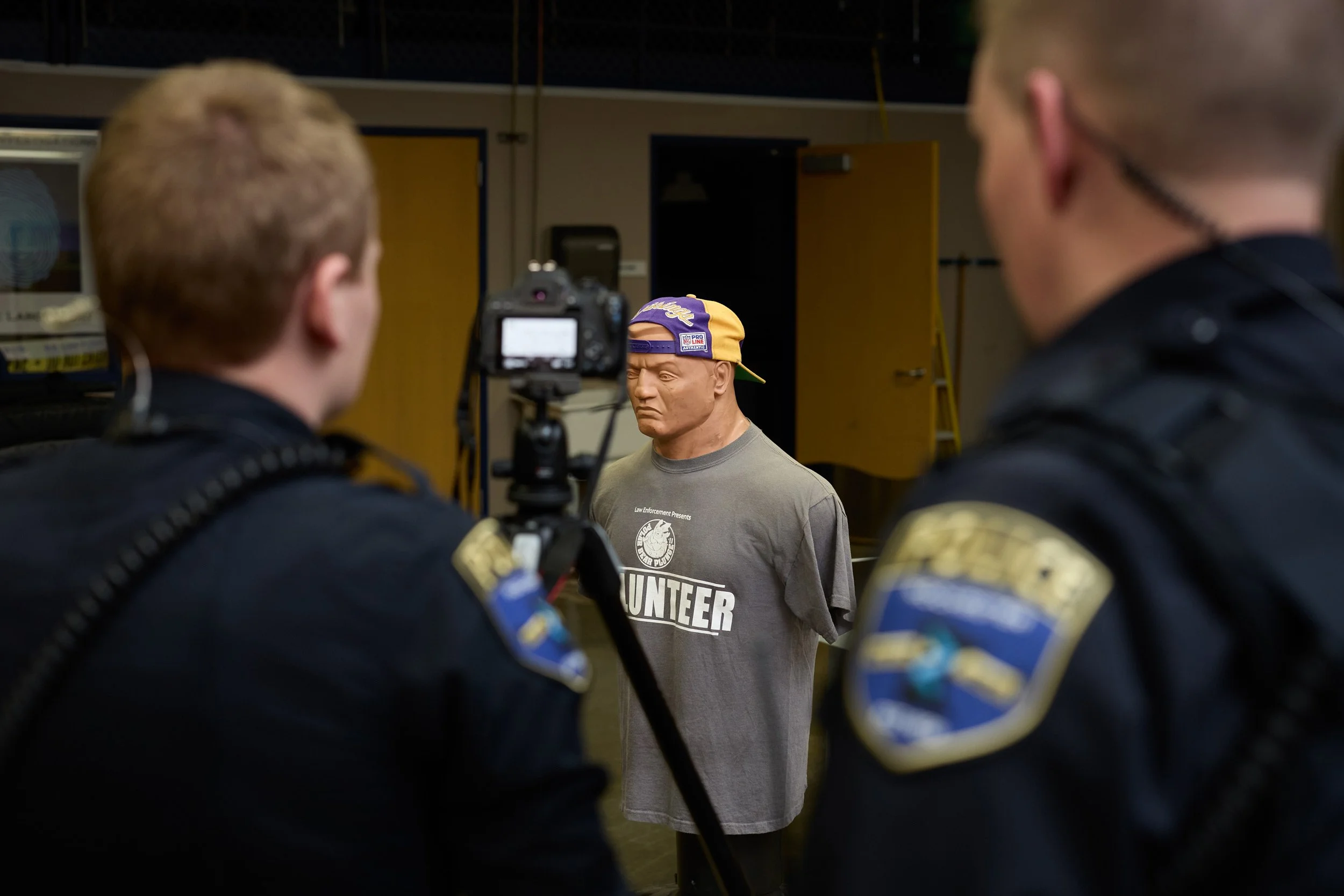
BOB is a human-looking punching bag. BOB wore a backwards Vikings baseball cap and a Polar Bear Plunge t-shirt that read, with no apparent irony, “VOLUNTEER.” BOB looked angry but did not flinch under harsh light, did not blink during long exposures, did not ask for breaks, and did not ask Scott to delete any unflattering frames. BOB is, by most metrics, the ideal photography subject.
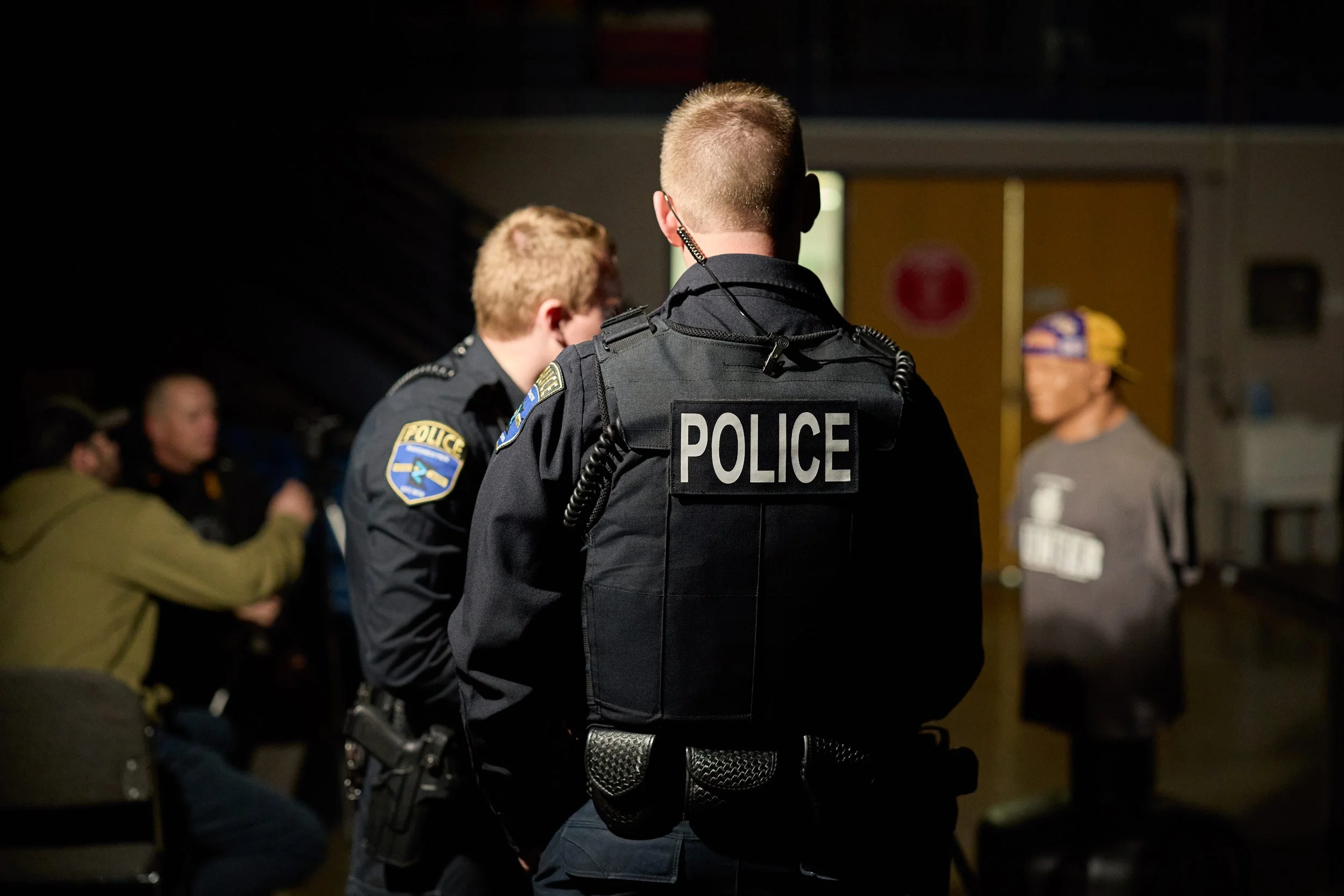
Officers used BOB to practice low-light long exposures — lining up tripod placement, dialing in shutter speeds, testing focus at distance, and seeing exactly how camera movement, subject placement, and ambient light interact when the shutter is open for several seconds. By the end of the session, BOB had been photographed more times than most engaged couples. He held up beautifully.
Why a Wedding and Portrait Photographer Was the Right Choice for This Class
There’s a reasonable question buried in this story: why bring in the guy who shoots families and physician headshots to teach forensic photography?
The honest answer goes back further than portraits. Before Scott devoted himself entirely to portrait photography, he spent more than fifteen years shooting weddings — hundreds of them, across the Midwest, in every venue, season, and circumstance you can imagine. It was the best training a photographer can get. No controlled conditions. No second chances. A single unscripted day with an immovable deadline, dim light, bad weather, equipment failures, and emotions running at full volume from start to finish. You come back with the photographs, or you don’t.
That’s not a portrait skill set. That’s a documentation skill set — the same one a police officer needs at 2 a.m. on a wet shoulder of Highway 52. Pivot when plans fall apart. Find the shot no matter what’s in the way. Wedding photographers and crash-scene photographers are solving the exact same problems: uncontrolled light, uncontrolled subjects, uncontrolled timelines, and a result that has to hold up to scrutiny.
Portrait photography, done at a high level, layers more of the same on top. Mixed lighting. Reflective surfaces (ever tried to photograph someone wearing glasses on a sunny day?). Color accuracy. Focus. The difference between a portrait photographer and a forensic photographer isn’t the camera — it’s what’s in the frame and what the photo has to prove.
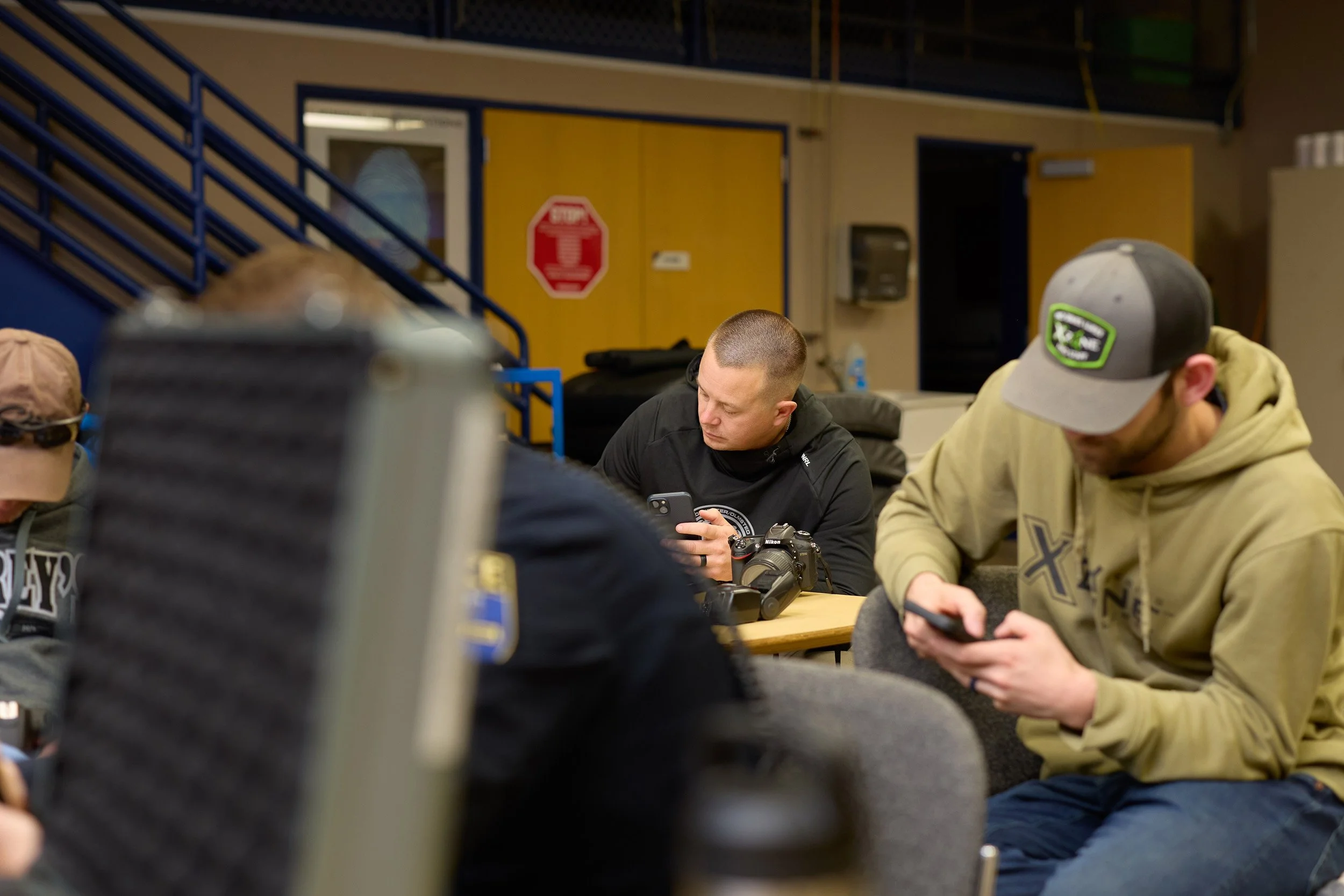
Scott has spent more than thirty years solving lighting and focus problems on the fly — first in high school darkrooms, then at hundreds of weddings, then in every kind of portrait setting Rochester throws at him. RCTC didn’t need a forensics specialist. They needed someone who could teach — clearly, patiently, with the kind of authority that comes from having actually done the work — and who could translate professional camera technique into language that working officers can use on their next call. That combination is rare. It’s why the class happened. It’s also why officers from two different agencies showed up to learn from a portrait photographer in a community college classroom in Rochester, Minnesota.
From Darkrooms to Squad Cars
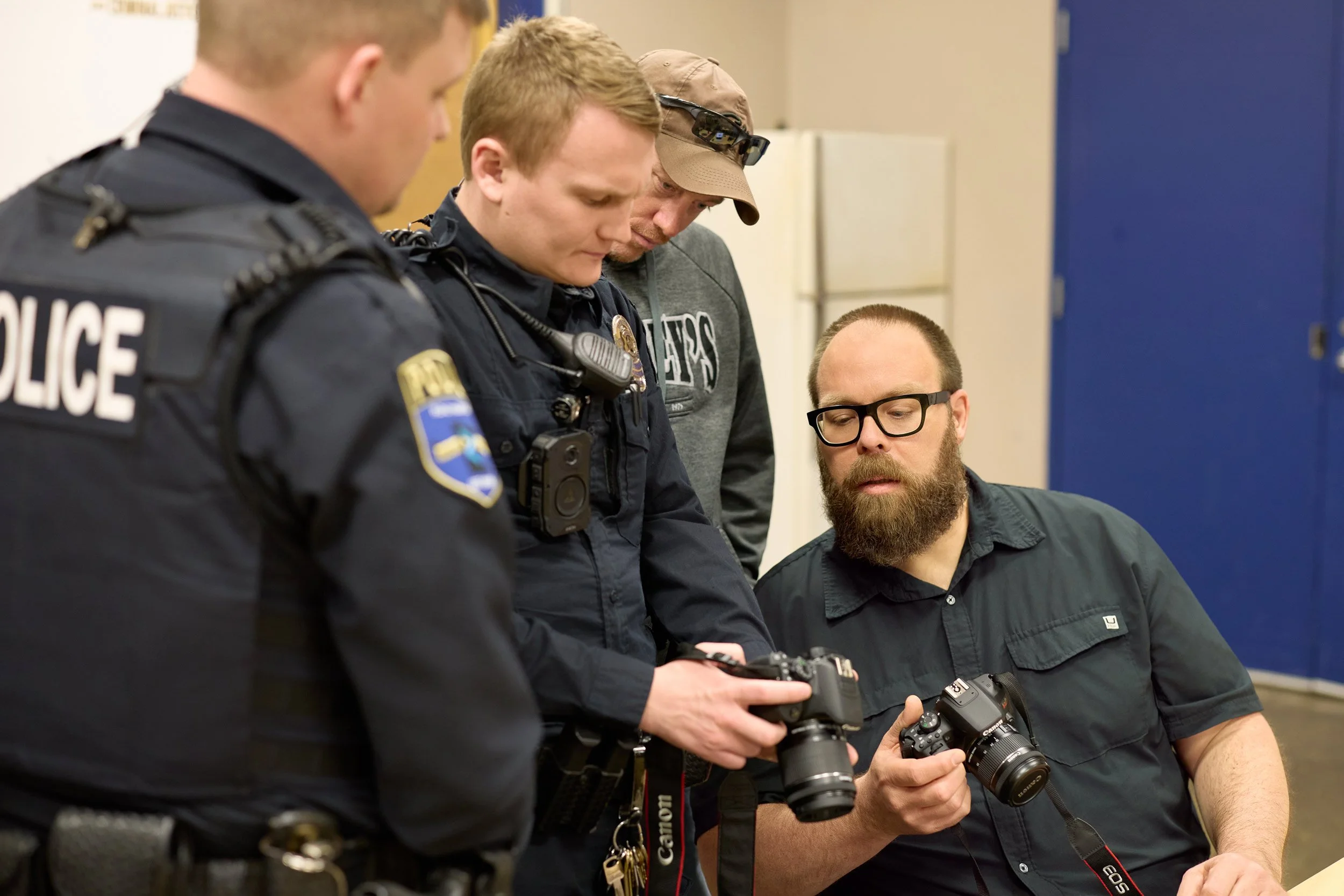
It’s a long way from a Chaska high school darkroom to an RCTC classroom full of Olmsted County deputies. But the job is the same one Mr. S has been doing for thirty years: take something technical and intimidating, break it down, and teach it in a way that respects the people in the room.
The students changed. The mission didn’t.
Scott still teaches. He still photographs. He still gets called in by professionals — physicians, attorneys, executives, agencies, and now police departments — who need someone who actually knows what they’re doing behind a camera. The long hair is gone (not by choice). The Saved by the Bell trivia…we cannot confirm or deny. His reputation is the same one his Chaska students figured out twenty-some years ago: this guy is the real thing.
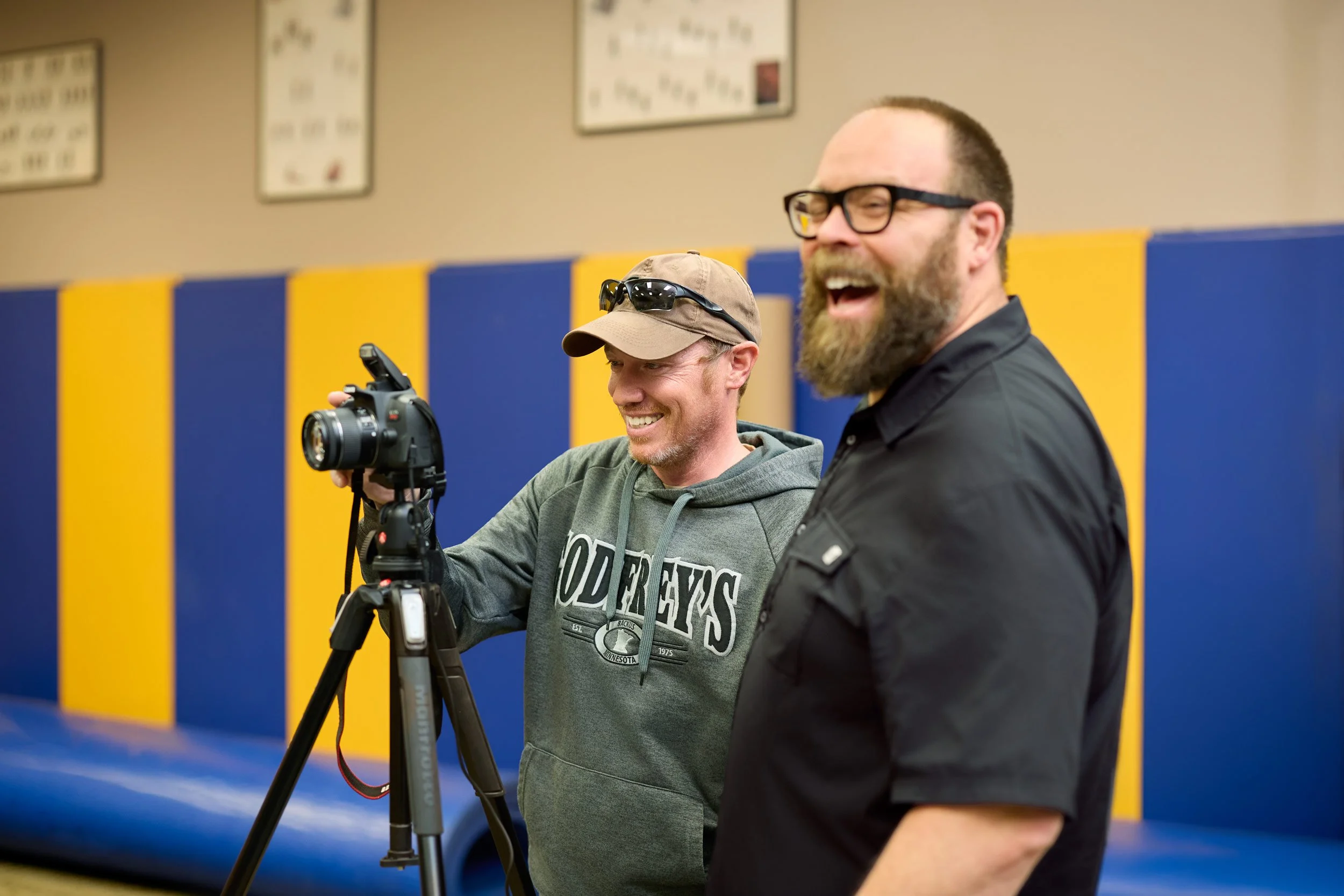
If you’re in Rochester or Olmsted County and you’ve got a photography problem worth solving — a portrait, a headshot, a team, a milestone, or a class full of officers — you know where to find him. He’s at Olive Juice Studios. The students just call him Scott now.